Showing posts with label Philip Purser-Hallard. Show all posts

Monday, 16 July 2018

The Book of the Enemy


...and there's another one, this time a collection edited by the excellent Simon Bucher-Jones and featuring written contributions from myself, Andrew Hickey, Philip Purser-Hallard, Lisa Sarah Good, Helen Angrove and others. It's available, as usual, as a proper printed book like God intended or as a series of zeroes and ones from Obverse Books, who still seem to have the first version of the cover on their site, for some reason.

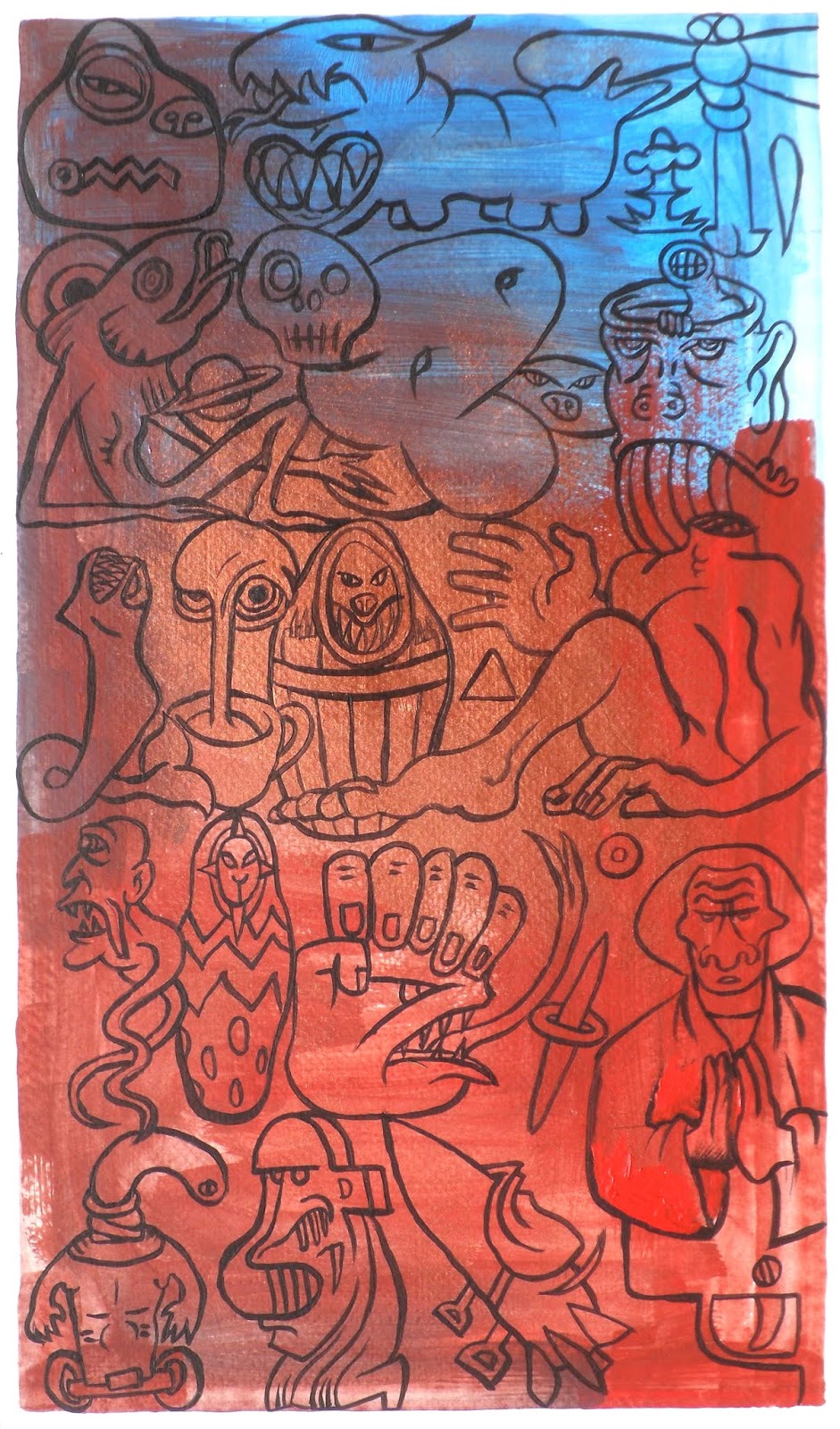
My contribution incorporates material recycled from an earlier draft of Against Nature, in case anyone cares, whilst being otherwise autobiographical because that seemed like the only way to write it which would make sense. My other contribution was the cover, of which the natural history is as follows - in the event of anyone wishing to save or repurpose any of this material for whatever ends. It began with a series of descriptions of bizarre creatures or objects written by Simon, which actually reminded me a little of the sort of things we used to see in Doug Allen and Gary Leib's Idiotland comic book; so I sort of took it from there, without worrying too much about the realism, or lack thereof.


Then:


 ...and then some highlights:


This image was used for the back cover, but was only ever intended as something I would paint over as a wash so as to have these vague images half-seen beneath the main one. Once I got started on the main figure, I got so much into it that I forgot to take photographs, so I only have an image of the finished thing. Never mind.


Tuesday, 17 May 2016

Furthest Tales of the City


What with Royal Mail losing my first complimentary copy in the post and a host of other stuff causing me to look in the other direction, I've just realised that I've thus far failed to spam the shit out of the most recent printed thing to which I've made some contribution. It actually came out last year, but better late than never, I suppose.

For anyone who missed the memo, Philip Purser-Hallard's Of the City of the Saved... is a novel set in a vast post-historical conurbation the size of our galaxy which has become home to every human being who ever lived, every partial-human being who ever lived, and even a few artificially birthed and formerly fictional-humans - Sherlock Holmes and the like. It answers the question what if the afterlife were real? in a science-fiction setting, and remains one of my all-time favourite novels. Since the publication of the novel, the author has edited a number of anthologies - four of them so far - of short stories set in this universe; and I've written a short story called Driving Home for Atonatiuh for the most recent of them. Here's an excerpt:


'Is there anything else I need to know?'

They were in one of the hangars a couple of miles outside of Black Rock, itself a microcosm of Urbem Automata of the Teletopia District. The light was dim, but not so dim as to conceal the vehicle, sleek red and yellow with a bubble of reinforced glass; and mounted at the back, fins so sharp as to remind Nanette of the obsidian knife she had envisioned slashing down within Mike's dim imagination a moment earlier.

'Well, you already know how to pilot one of these babies, Nanette. There isn't much more I can tell you.' He regarded her for a moment. 'It's very much like driving a car, I guess you could say.' His eyes were still and unnerving, more so than was usual for citizens of Urbem Automata.

Some months ago Nanette had realised that Mike's skull could not be of sufficient volume to contain both of those eyes if they were truly spherical, as they would be were he an ordinary baseline human. Being as he was a remake, she assumed his eyes to be simple curved surfaces set into his face, shallow sensory organs grown so as to resemble an approximation of the human eye, with mobile iris and pupil for the sake of appearances.

'I know what you're thinking,' he continued at last, 'but this here is one of the prototypes. Tried and tested, it's completely reliable. You won't need to worry about accidents so long as you drive safely.'

'Okay.' She was surprised to realise that for once he had known what she was thinking. She had believed the vehicle to be unique, and was glad that this was not the case. There didn't seem to be any other way of her returning to Atonatiuh, and the need to get a move on was almost beginning to hurt.

'Hey, Mercury - you gonna be all day? I gotta close this place up.'

The voice came from some technician who stood wobbling near the double doors. The accent sounded like old Brooklyn, or an exaggerated version thereof. He held an oversized spanner in one hand.

'We'll be done soon.' Mike waved back, then turned to Nanette. 'You about ready to get going here?'

She momentarily stared at his eyebrows, thick dark strips of coconut matting sitting at angles across his face - ridiculous. She really needed a break from this.

'Yes, I'm ready, Mike.'

...and thus does she fly off in a fictional car which must remain unidentified for reasons of copyright.


Cough. Cough.

...thus does she fly off to undergo the usual Mexican-themed adventures packed with bewildering mythological references; and mine is just one of seven-ish similarly cranky short stories contained therein. You should totally buy one. You'll love it, I swear.

Furthest Tales of the City is available in electronic form or as a PROPER BOOK from yonder website.

Thursday, 15 August 2013

Smoking Mirror


I produced a POD version of
Smoking Mirror some time ago, so it really is old and probably not very interesting news. Nevertheless, it's just popped up as a topic of minor curiosity on the Outpost Gallifrey forum, presumably someone working their way backwards from my more recent, arguably more legitimate written efforts; and I realised I'd never got around to reposting this 2011 review from Andrew Hickey's wonderful Sci-Ence! Justice Leak!, so here it is:

Obligatory disclaimer-cum-explanation as to why I've bought this book. I've vaguely known Lawrence Burton as one of the more intelligent posters on the Doctor Who forum Outpost Gallifrey and on the Faction Paradox forum for a year or two. We've recently become Facebook friends, and he wrote a very flattering review of my most recent book. So I may be biased here.

On the other hand, I don't know him well enough that I think I'm biased - and if you read through that thread (Lawrence reviewing several hundred science fiction books) it's obvious both that he can actually write, and also that he shares a number of my tastes - of the books we've both read, I'd say I agree with at least 80% of his reviews, and especially the stuff he's most glowing about (Philip K. Dick, Lawrence Miles, David Louis Edelman) and his tastes in individual works by writers (preferring The End Of Eternity and The Gods Themselves to Asimov's Robot stuff).

So when I saw he'd self-published a couple of books himself, I bought this one without even reading the description.

It turns out to be an unofficial Doctor Who novel. I'd hesitate to call it fanfic, partly because it was intended for BBC Books (and quite why it was rejected I can't understand) and partly because fanfic tends to suggest something of poor quality, and this is anything but. It's a Doctor Who novel that happens not to have been licensed by the BBC, that's all. (Lawrence is selling the book at cost price and not making a penny from it, I hasten to add).

Given that it's self-published, there are surprisingly few criticisms I can make of it. The review thread linked above is called Crappy 70s Paperbacks with Airbrushed Spaceships on the Cover, and the cover design is a perfect imitation of those, the typography on the back being spookily reminiscent of some of them (the closest comparison I can find is the Granada paperback copies of The End Of Eternity and The Zap Gun, but I know I've seen something even closer). However, the typography in the book itself is less wonderful, being in Times New Roman (or a facsimile thereof) and eight- or ten-point type. Having a legally-blind wife, I know from experience that ideally one should print things in at least twelve-point, and wherever possible use a sans-serif font, for readability.

Other than that, the only really jarring thing about the book is a moment of lampshade hanging, when the Doctor is on a collect-the-plot-tokens quest and thinks about how he hates this kind of thing when it happens in books. It's not done quite well enough to overcome the problems.

One other problem I have - and one that's my problem rather than the book's - is that the book is set in pre-Columbian Mexico, and so the characters' names are all phonetically unlike anything I'm accustomed to. This gave me some difficulty in keeping track of the characters, but that can hardly be helped, given the subject.

The plot is a pretty good one - why has the universe shrunk, so that it now consists of only a small area of Central America and a few centuries? Why are the Gods walking among the humans? - but the plot is less important than the writing. Lawrence obviously has a huge love for the Mexica culture and mythology, and this comes across in every word. Before I read this, all I knew of the Mexica culture was that some of their sculptures in the British Museum look like they'd been made by Jack Kirby, if Kirby had had an obsession with skulls (which is a good thing). But Lawrence manages both to make this seem like a sympathetic culture (putting even the human sacrifice into a context where it seems entirely reasonable) and to bring out the utter strangeness of the culture's myths.

A lot of individual scenes will stay with me for a long time - the Doctor getting an inkling that problems are starting when Carl Sagan starts talking about how the Earth is a few thousand years old, the god at the centre of the TARDIS, the journey through Mictlan - this is a book as much about the journey as the destination, and Lawrence isn't afraid of devoting time to his interests, whether that be retelling old myths or explaining Mexica social structure or making asides about old sitcoms.

In fact, after the obvious in-joke that the Third Doctor used to watch Dad's Army (which starred Bill Pertwee) I started wondering about the other references - what does the confirmation of a Doctor-Who-universe Wilfred Brambell and Tony Hancock mean for the careers of the 'Whoniverse' Ron Grainer and Terry Nation? - but that's just the 60s-TV fan in me coming out.

And there's a very sitcom feel about parts of this book, but in a good way. It's a funny book, but the humour all flows from the situations, whether it be the Doctor's other console rooms (I want to see the McConsole Room™ now) or the TARDIS translation circuit malfunction that renders speech more… idiomatically than before. The one funny bit that doesn't quite fit in is the bit with three priests (trying not to spoil anything here). But that is so funny - and so incongruous - that it works, even though it could easily have fallen into the too-common trap of mistaking a reference for an actual joke.

The characterisation is spot-on as well. Lawrence catches Peri's voice perfectly, and his Sixth Doctor is definitely Colin Baker (although the character here is closer to the TV series than to the more nuanced portrayal in the audio stories - understandably, as this was written in 2002, when the audios hadn't been going that long). At times the Doctor seems almost too verbose, but then this is a Doctor whose defining writers were Pip & Jane Baker, and the fact that nobody else talks like that shows it as a stylistic choice rather than a tin ear.

It's a first novel, with all that that entails, and Lawrence's influences are clear (and he thanks Philip Purser-Hallard and Simon Bucher-Jones in the acknowledgements, if it hadn't been obvious) - I'm sure the use of Mictlan here is at least in part a reference to its use in the Faction Paradox books - but while this doesn't rise to the level of the very best Doctor Who books, it's funny, clever, well-written and written by someone with an obvious love for his subjects - both Doctor Who and pre-Columbian Mexica culture - and is certainly better than a good 90% of the Doctor Who books I've read.

Now if only Air France hadn’t lost my bag with my DVD of The Aztecs in, I could do a compare / contrast here. Oh well…

I wouldn't necessarily recommend this to a non-fan of Doctor Who, but it's an excellent self-contained story which requires a minimum of continuity knowledge, so if you're even a casual fan - especially if you're a fan of the Sixth Doctor, who's otherwise even worse-served in print than on TV - this is well worth a read. I'll definitely be buying Lawrence's book of short stories.

So there you go - that all seems fair. It's available here if anyone's tempted.

Finally, I should probably stress for the benefit of the three of you to whom this might make any sense, although Smoking Mirror shares a setting with Against Nature, it's a distant ancestor rather than a direct relative, and certainly isn't the first draft of the more recent title.

Wednesday, 1 May 2013

Against Nature: Four Stars on Goodreads

Well, I was bored...

And another review of
Against Nature, this time as posted on Goodreads on the 30th April by Philip Purser-Hallard, himself a genuinely exceptional author whose own entry into the Faction Paradox canon, Of the City of the Saved... would easily rate amongst my all-time top ten science-fiction novels were I ever to attempt to pin down such a grouping. Whilst it would be untrue to suggest that I might have packed in writing to become a pole dancer had Phil given my novel the thumbs down, it would have nevertheless been a dark day, so this feels somewhat akin to Henry Rollins telling me my band rocks (conditional to some scenario in which I actually have a band):

There are some issues with the use of language in this novel: Lawrence Burton's knowledge of Mexica culture is rich and detailed and his research is meticulous, but Against Nature doesn't work with the reader to allow them to understand it as well as he does. In some ways that's admirable - as a reader I'm always willing to put in some work to understand a book rather than having its meanings handed to me on a plate - but despite the culture's inherent fascinations, the sheer profusion of unfamiliar terms did become a little alienating.

However, it's exactly the same approach taken to the material set among the inhabitants of the Great Houses, which I found much more comprehensible, and indeed to the contemporary US scenes - we're so immersed in the viewpoint of the current primary character that what they see is presented to us with no more explanation than they themselves would need. I'm confident that an early sixteenth-century Mexica cleric or a Homeworlder, if they were somehow able to read the book, would find exactly as much that was baffling about the contemporary sections.

As I say, I don't mind putting in the work to understand a story - it’s a common expectation in SF (see such books as Neuromancer or A Clockwork Orange), and one becomes used to it - but it’s not exactly restful to read. Couple that with the fivefold alternation between what for much of the book are separate plot strands, and a family life which means that I mostly get to read when I'm already tired, and I quite often picked up the book and found that I had absolutely no idea what was going on. I found it quite slow going.

Much of that is to do with my reading habits, though - I'm sure a younger, more intellectually agile reader would have had no issues with it. The one place where I thought this approach seriously compromised the book was in the suggestion that the actions of the various time-active participants had altered the mythology of the Mexica people, since without a comprehensive knowledge of said mythology it was impossible to detect which aspects of the myths depicted had been culturally imperialised.

That's it for the negatives, though. In a more general way, I loved the use of Aztec myth, religion and ritual, and the descriptive tours of Tenochtitlan and its environs, as well as its modern-day counterpart and the connections between the two. The bruja Ultima, with her matter-of-fact approach to ritual magic, was a particularly fine character, but Momacani (the Mexica cleric whose passages are naturally the most steeped in Nahuatl vocabulary) was also reassuringly sympathetic. The play with alternative timelines was fun - not just the revelation about Todd's relationship to Primo, but also the fractured present-day USA in which the former apparently finds himself about halfway through the book.

The book is crammed full of fascinating ideas, in fact, and its plot is wonderfully twisty, yielding up unexpected linkages between its apparently disparate strands, and building up to a climax whose ill-defined, partial and ambiguous nature is entirely in keeping with the book's presentation of the numinous and sacred. The biggest question of all - Goralschai's true intent - is ultimately unanswerable without an insight into the Ordnance-Tetrarch's thought processes which the book denies us, and I felt it was all the more satisfying that way.

I loved the House Meddhoran sections of the book, and their depiction of an alien but codified world being invaded by the weird, irrational and macabre. (From a smugly personal point of view, I was gratified to see that the Great Houses' vocabulary now includes a couple of my own coinages, specifically archemathics and childe.) The eventual humanisation of these childrene whom the Houses have rejected was touchingly done.

It's difficult for me to rank Against Nature in quality with the six previous Faction Paradox novels from Mad Norwegian and Random Static, even leaving my own horse out of the race... but as the first full-length novel Obverse Books have published, it's suitably impressive, and gives me a great deal of confidence in the quality of the range to come.