Showing posts with label Andrew Hickey. Show all posts

Monday, 16 July 2018

The Book of the Enemy


...and there's another one, this time a collection edited by the excellent Simon Bucher-Jones and featuring written contributions from myself, Andrew Hickey, Philip Purser-Hallard, Lisa Sarah Good, Helen Angrove and others. It's available, as usual, as a proper printed book like God intended or as a series of zeroes and ones from Obverse Books, who still seem to have the first version of the cover on their site, for some reason.

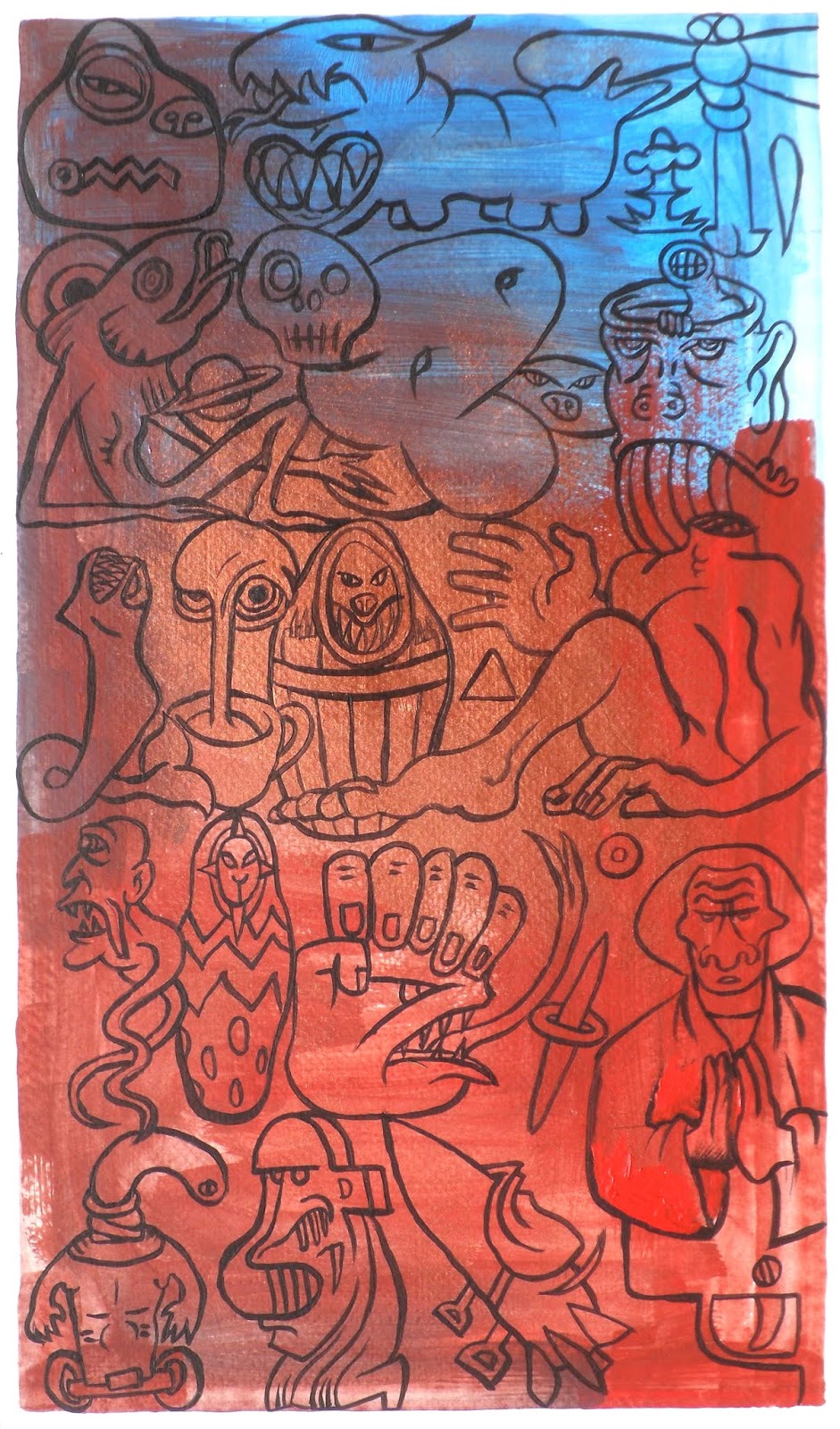
My contribution incorporates material recycled from an earlier draft of Against Nature, in case anyone cares, whilst being otherwise autobiographical because that seemed like the only way to write it which would make sense. My other contribution was the cover, of which the natural history is as follows - in the event of anyone wishing to save or repurpose any of this material for whatever ends. It began with a series of descriptions of bizarre creatures or objects written by Simon, which actually reminded me a little of the sort of things we used to see in Doug Allen and Gary Leib's Idiotland comic book; so I sort of took it from there, without worrying too much about the realism, or lack thereof.


Then:


 ...and then some highlights:


This image was used for the back cover, but was only ever intended as something I would paint over as a wash so as to have these vague images half-seen beneath the main one. Once I got started on the main figure, I got so much into it that I forgot to take photographs, so I only have an image of the finished thing. Never mind.


Monday, 11 July 2016

A Target for Tommy


I'm never quite sure what to make of charity anthologies because there seems to be a million of them, and the cause usually looks like a bit of an afterthought from where I'm stood, plus when it comes to Who fiction, I'm not convinced we really need any more, and I'm generally keen to encourage people to read things which aren't Doctor Who.

But what the fuck do I know?

Stuart Douglas of Obverse Books asked me to write something for this, proceeds of which go to someone whom I don't actually know but who seems like a good guy and could clearly use a break, and it just seemed like it would be a extraordinarily wanky of me to say no. So as instructed I had fun with my story which, for those who may care about such things, occurs immediately after the events of The Two Doctors, or my own prehistoric fan novel Smoking Mirror, or Against Nature, or all three, with a special appearance by Señor 105, so that's a whole stack of premium grade fanwank right there.

You're welcome.

Without any conspicuous display of shame or modesty, here's my favourite passage from my own story which is, by the way, called The Time Wrestlers:

'Your people may be the masters of all time and space,' said the luchador in a voice rich with martial confidence, 'but when it comes to fighting as would a man, you seem lacking in certain departments, if you don't mind my saying so.'

The muffled response of a pained not at all sounded from beneath the huge wrestler's bottom, which had now made a seat of the Doctor's face.

There are also contributions from Paul Magrs, Sarah Hadley, Andrew Hickey, Nick Campbell, Rachel Redhead, Blair Bidmead, Simon Bucher-Jones, Paul Cornell plus a whole load of other names who can likewise be relied upon to spin a good yarn in my experience; so if this sounds like your sort of thing, then you will definitely need to buy a copy or two, or maybe even three; except you can't because it's still being edited and printed and whatnot, but you can put in a pre-order right now by following this link. So that's what you should do.

You can find out a little more about what Tommy has been going through by following his blog here.
 

Monday, 29 June 2015

Head of State


Head of State is the new Faction Paradox novel for which I painted the cover. The eBook is already available, and the paperback will be available very soon from Obverse Books, the website of which is to be found by following this link, by hovering the little arrow over the underlined word link and then clicking - which I only mention as this apparently becomes very complicated when feigning interest in independently published books by people you actually know for the sake of politeness, such as my old pal who promised to buy my own effort when it came out in paperback, somehow missing the point that it was the feckin' paperback to which I was referring...

Anyway, Head of State is written by Andrew Hickey. I haven't yet read it myself, but I've read excerpts, and many other things written by Andrew, and so I'm reasonably confident it will be good, great, or possibly even exceptional.

So once again, as this is apparently quite difficult:

I have painted the cover for this book.

I did not write it.

My friend wrote it.

I think it will be good.

You should read the synopsis on the Obverse Books website, and then make a decision as to whether you think it might be your sort of thing.

If it seems like this isn't the sort of book you are likely to enjoy reading, then you are under no obligation to buy a copy.

If it seems like Head of State might be right up your street, then please order a copy from this site.

Thursday, 15 August 2013

Smoking Mirror


I produced a POD version of
Smoking Mirror some time ago, so it really is old and probably not very interesting news. Nevertheless, it's just popped up as a topic of minor curiosity on the Outpost Gallifrey forum, presumably someone working their way backwards from my more recent, arguably more legitimate written efforts; and I realised I'd never got around to reposting this 2011 review from Andrew Hickey's wonderful Sci-Ence! Justice Leak!, so here it is:

Obligatory disclaimer-cum-explanation as to why I've bought this book. I've vaguely known Lawrence Burton as one of the more intelligent posters on the Doctor Who forum Outpost Gallifrey and on the Faction Paradox forum for a year or two. We've recently become Facebook friends, and he wrote a very flattering review of my most recent book. So I may be biased here.

On the other hand, I don't know him well enough that I think I'm biased - and if you read through that thread (Lawrence reviewing several hundred science fiction books) it's obvious both that he can actually write, and also that he shares a number of my tastes - of the books we've both read, I'd say I agree with at least 80% of his reviews, and especially the stuff he's most glowing about (Philip K. Dick, Lawrence Miles, David Louis Edelman) and his tastes in individual works by writers (preferring The End Of Eternity and The Gods Themselves to Asimov's Robot stuff).

So when I saw he'd self-published a couple of books himself, I bought this one without even reading the description.

It turns out to be an unofficial Doctor Who novel. I'd hesitate to call it fanfic, partly because it was intended for BBC Books (and quite why it was rejected I can't understand) and partly because fanfic tends to suggest something of poor quality, and this is anything but. It's a Doctor Who novel that happens not to have been licensed by the BBC, that's all. (Lawrence is selling the book at cost price and not making a penny from it, I hasten to add).

Given that it's self-published, there are surprisingly few criticisms I can make of it. The review thread linked above is called Crappy 70s Paperbacks with Airbrushed Spaceships on the Cover, and the cover design is a perfect imitation of those, the typography on the back being spookily reminiscent of some of them (the closest comparison I can find is the Granada paperback copies of The End Of Eternity and The Zap Gun, but I know I've seen something even closer). However, the typography in the book itself is less wonderful, being in Times New Roman (or a facsimile thereof) and eight- or ten-point type. Having a legally-blind wife, I know from experience that ideally one should print things in at least twelve-point, and wherever possible use a sans-serif font, for readability.

Other than that, the only really jarring thing about the book is a moment of lampshade hanging, when the Doctor is on a collect-the-plot-tokens quest and thinks about how he hates this kind of thing when it happens in books. It's not done quite well enough to overcome the problems.

One other problem I have - and one that's my problem rather than the book's - is that the book is set in pre-Columbian Mexico, and so the characters' names are all phonetically unlike anything I'm accustomed to. This gave me some difficulty in keeping track of the characters, but that can hardly be helped, given the subject.

The plot is a pretty good one - why has the universe shrunk, so that it now consists of only a small area of Central America and a few centuries? Why are the Gods walking among the humans? - but the plot is less important than the writing. Lawrence obviously has a huge love for the Mexica culture and mythology, and this comes across in every word. Before I read this, all I knew of the Mexica culture was that some of their sculptures in the British Museum look like they'd been made by Jack Kirby, if Kirby had had an obsession with skulls (which is a good thing). But Lawrence manages both to make this seem like a sympathetic culture (putting even the human sacrifice into a context where it seems entirely reasonable) and to bring out the utter strangeness of the culture's myths.

A lot of individual scenes will stay with me for a long time - the Doctor getting an inkling that problems are starting when Carl Sagan starts talking about how the Earth is a few thousand years old, the god at the centre of the TARDIS, the journey through Mictlan - this is a book as much about the journey as the destination, and Lawrence isn't afraid of devoting time to his interests, whether that be retelling old myths or explaining Mexica social structure or making asides about old sitcoms.

In fact, after the obvious in-joke that the Third Doctor used to watch Dad's Army (which starred Bill Pertwee) I started wondering about the other references - what does the confirmation of a Doctor-Who-universe Wilfred Brambell and Tony Hancock mean for the careers of the 'Whoniverse' Ron Grainer and Terry Nation? - but that's just the 60s-TV fan in me coming out.

And there's a very sitcom feel about parts of this book, but in a good way. It's a funny book, but the humour all flows from the situations, whether it be the Doctor's other console rooms (I want to see the McConsole Room™ now) or the TARDIS translation circuit malfunction that renders speech more… idiomatically than before. The one funny bit that doesn't quite fit in is the bit with three priests (trying not to spoil anything here). But that is so funny - and so incongruous - that it works, even though it could easily have fallen into the too-common trap of mistaking a reference for an actual joke.

The characterisation is spot-on as well. Lawrence catches Peri's voice perfectly, and his Sixth Doctor is definitely Colin Baker (although the character here is closer to the TV series than to the more nuanced portrayal in the audio stories - understandably, as this was written in 2002, when the audios hadn't been going that long). At times the Doctor seems almost too verbose, but then this is a Doctor whose defining writers were Pip & Jane Baker, and the fact that nobody else talks like that shows it as a stylistic choice rather than a tin ear.

It's a first novel, with all that that entails, and Lawrence's influences are clear (and he thanks Philip Purser-Hallard and Simon Bucher-Jones in the acknowledgements, if it hadn't been obvious) - I'm sure the use of Mictlan here is at least in part a reference to its use in the Faction Paradox books - but while this doesn't rise to the level of the very best Doctor Who books, it's funny, clever, well-written and written by someone with an obvious love for his subjects - both Doctor Who and pre-Columbian Mexica culture - and is certainly better than a good 90% of the Doctor Who books I've read.

Now if only Air France hadn’t lost my bag with my DVD of The Aztecs in, I could do a compare / contrast here. Oh well…

I wouldn't necessarily recommend this to a non-fan of Doctor Who, but it's an excellent self-contained story which requires a minimum of continuity knowledge, so if you're even a casual fan - especially if you're a fan of the Sixth Doctor, who's otherwise even worse-served in print than on TV - this is well worth a read. I'll definitely be buying Lawrence's book of short stories.

So there you go - that all seems fair. It's available here if anyone's tempted.

Finally, I should probably stress for the benefit of the three of you to whom this might make any sense, although Smoking Mirror shares a setting with Against Nature, it's a distant ancestor rather than a direct relative, and certainly isn't the first draft of the more recent title.

Wednesday, 3 July 2013

Andrew Hickey on Against Nature

Tepoztlan, 2005.
This time a review of my leaflet from Andrew Hickey, posted originally on his excellent blog Sci-Ence! Justice Leak!

Full disclosure before I start this - I am friendly with the author and the publisher, and I also potentially have a book coming out from this publisher. I don’t think that this has biased my opinions in any way - I became friendly with them because we shared a lot of tastes, so it's unsurprising that I would then enjoy this book - but it's only fair to point out up-front.

I've been putting off reviewing this one for quite some time, because as I've said before I've not been thinking very well for the last few months due to ill-health, and this is a book that deserves a more considered, thoughtful response than perhaps I am able to give. However, I'm still not fully well, and don't know how long I would have to wait otherwise, so this is my best assessment given my limited faculties.

Against Nature is a fascinating, difficult book, that makes no concessions to the reader but is all the better for it. It's dense, allusive, and expects its reader to think - but it gives plenty to think about. This is Faction Paradox in big, important, thoughtful mode, rather than light adventure mode - think Newtons Sleep or, especially, This Town Will Never Let Us Go rather than Erasing Sherlock or Warlords Of Utopia. I've read it twice, and I still haven't got all of it, but that's a good thing - this is a book that absolutely rewards rereading.

I loved it.

I'm mistletoe, Todd thought, I was living on that tree, and now I'm cut off, just moving forward until I sputter out. He wondered if this life might present him with other obvious symbols for his consideration, truths revealed in the everyday details. It felt a little like this whole world was all for his benefit, so maybe.

Against Nature is about sacrifice, and the nature of sacrifice, about dying-and-resurrected gods (and ones that die without resurrection), about what it means to be cut off from one's culture and one's past. It's a book that could only have been written by someone profoundly disconnected from his own culture - and it's no surprise that between writing the early drafts of this, and its final publication, Lawrence emigrated to the US.

The same injustice had befallen Europe a few centuries earlier, barbarians at the gates and so on, swords turning out to be mightier than pens despite the proverb. It was always the stupid idea that caught on, the story that even the village idiot could follow without giving himself a headache. Human history was a ratings war, and people would always choose the flashing lights, special effects, and generic hero pleading you don't have to do this! over things of value.

One of the ways in which Lawrence creates this effect has been misunderstood by several of the readers, particularly on some Doctor Who forums (Faction Paradox still has a residual connection to what Lawrence refers to as Magic Doctor Who Man Telly Adventure Time). The book is set in multiple times, in multiple locations, with multiple cultures. Two of those cultures - the Great Houses and the medieval Mexica people (the people we think of, wrongly, as the Aztecs) are ones which are very, very different from the likely cultures of any of the readers, not only in behaviour and attitudes, but in language.

Lawrence throws us in at the deep end, cutting rapidly, every two or three pages, between wildly different locations and time periods, with stories that parallel and comment upon each other, but do not link up until near the end. Each of these different cultures is presented to us without comment or explanation, so our first glimpse of the Great Houses' culture comes with:

The blinkers were fashioned from the clothing of the deceased, specifically a pressure suit once belonging to Herrare, the material cut to form a collar of hide curving around the eyes in the manner of goggles. Emioushameddhoran vel-Xianthellipse adjusted the knotted strips of fabric which kept the blinkers in place and took a moment to inspect herself in the cheval glass.

while the Mexica strand of the story starts:

It was the day Ome Ozmatli of the trecena Ce Izcuintli as reckoned by the Tonalpohualli calendar of the Mexica - Two Monkey, presiding Deities being Xochipilli, Xipe Totec and Quetzalcoatl. This was hardly an auspicious combination by which to embark upon travel, but there being only nine days left before the occasion of the impending New Fire Ceremony, Momacani was left with little choice.

The cultures involved are ones which Lawrence has an expert understanding of - he has been studying the Mexica people for decades, and has been involved in Faction Paradox fandom (for want of a better word) for almost as long. The result is that he can write about these cultures fluently, from the perspective of someone who lives there, because he does, at least internally.

Several readers complained about the fact that they had to keep track of unfamiliar names like Emioushameddhoran and terms like Ce Izcuintli, and there is no question that this does make the book many times more difficult to read than it otherwise would be. But this seems to me to be entirely intentional - the reader experiences a miniature culture shock every two to five pages, and has to assimilate everything with no background. One is as rootless as Todd, the closest thing to an audience-identification figure in this book.

But I'm making this sound like it's a hard slog, something to read out of a sense of duty, and it's anything but. It's a clever, thoughtful, sometimes funny, always thought-provoking book, and will almost certainly prove the best novel I read this year.